By: Dana Poul-Graf, Founder & Strategic Thought Partner, Key&Spark
“I know exactly what you mean.”
We usually say it to make someone feel understood.
But sometimes it can do the opposite.
Imagine someone telling you they are trying to deliver several major change programs while operations are at their peak and the team is already stretched.
You’ve been there.
Almost instinctively, you reach for your own experience.
“When I was…”
It feels like connection. A way of saying: You’re not alone. I know what this feels like.
But something subtle may have happened at the same time.
We may have decided too quickly that we understand.
The strength and risk of experience
Experience is enormously valuable.
It gives us pattern recognition. We recognize dynamics more quickly, anticipate what may happen next and draw on situations we have encountered before.
That is part of what makes experienced leaders, advisors and specialists valuable.
But the same capability carries a risk.
Once we recognize a familiar pattern, our attention can shift from understanding the situation in front of us to what we already know about situations like it.
A story here. An example there. Something we learned that might genuinely help.
None of this needs to come from ego. Quite the opposite. It can come from having accumulated so much experience that we almost always have something relevant to contribute.
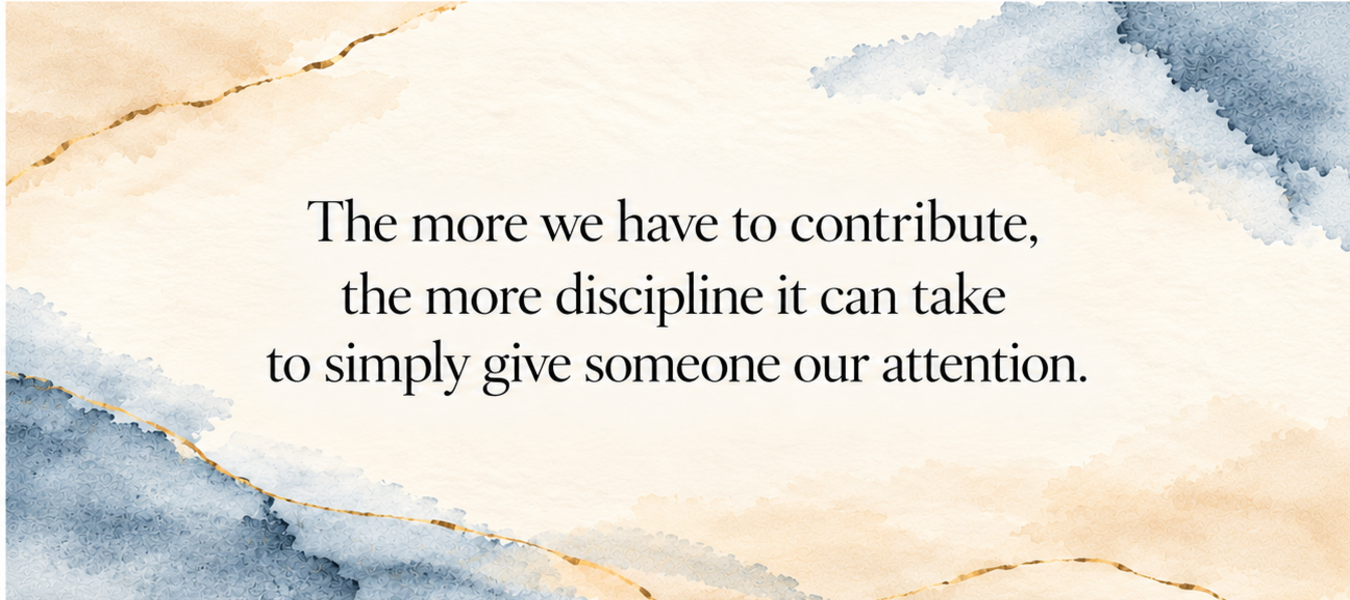
The more we have to contribute, the more discipline it can take to simply give someone our attention.
Pattern recognition is a starting point, not a conclusion
What looks familiar may indeed be familiar.
But the person, context, relationships, constraints and consequences are different.
Sometimes one more question reveals that the issue is not quite the one we thought we recognized.
Sometimes the other person is not yet looking for an answer at all. They are still making sense of what is happening.
And sometimes our experience is most useful when we don’t immediately put it into words.
We can use it to recognize the pressure.
To notice what might matter.
To ask a better question.
To stay with the other person’s experience a little longer.
The story is still there. We just don’t automatically need to tell it.
Knowing when not to contribute yet
In leadership, consulting and trusted partnerships, experience matters enormously.
The answer is not to suppress it or pretend we don’t see patterns.
It is to hold what we think we recognize lightly enough to remain curious.
Perhaps one sign of experience is not only knowing what you could contribute.
It is also knowing when not to contribute it yet.
At Key & Spark, we work with leaders and teams on the less visible dynamics that shape judgment, communication and decision-making, particularly when situations are complex and familiar answers may arrive too quickly.
Sometimes one more question changes what we thought we understood. If this is a capability you want to strengthen in your leadership or your team, we’d be glad to explore it with you.